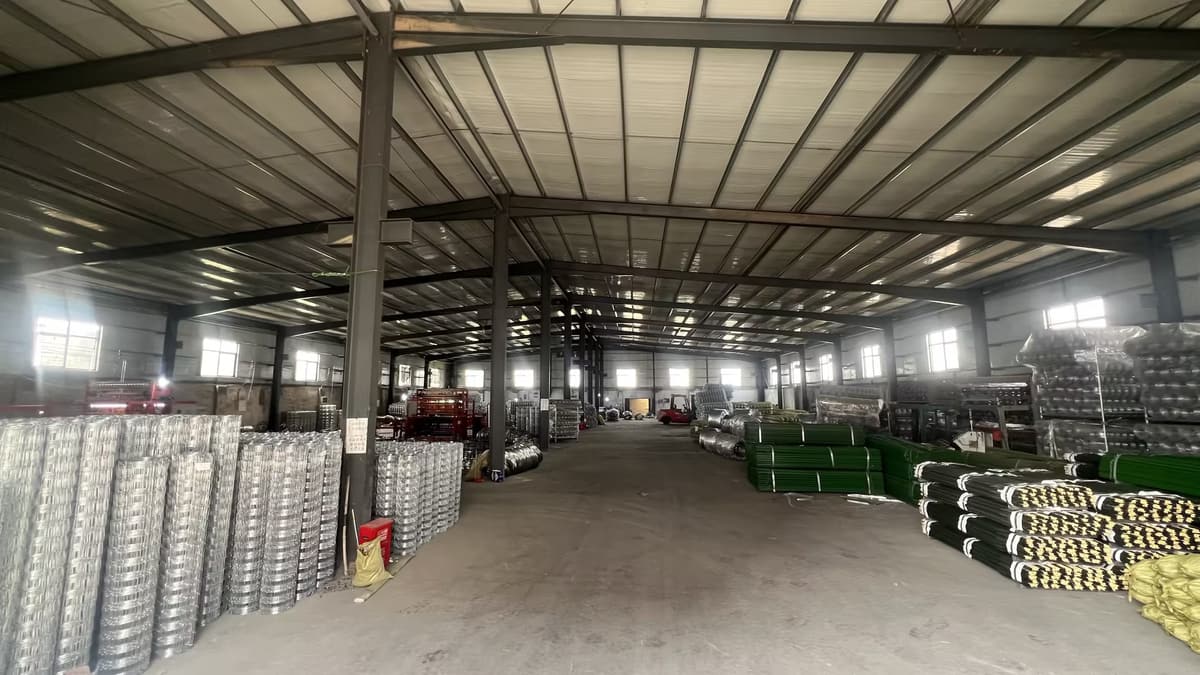
The right fence depends on the animal. Cattle, sheep and deer each push on a fence in their own way, so matching the mesh, height and knot type to your stock saves money and prevents escapes. Here is a practical guide for international buyers, built on what actually fails in the field.
At a glance
- Cattle: 90–115 cm hinge-joint fence with 8–11 line wires; add a barbed top wire if needed.
- Sheep: 80–90 cm hinge-joint fence with tight lower stays to stop lambs pushing through.
- Deer: 150–190 cm rigid ring-lock fence that holds its shape under impact.
- Goats / mixed stock: fence for the most demanding animal; use tight mesh and ring lock where pressure is highest.
- Coastal / wet regions: use heavy zinc coating (200 g/m² on 2.0 mm wire, 230 g/m² on 2.5 mm wire).
Cattle
Cattle lean and rub rather than jump. The fence has to absorb steady weight without distorting, so a hinge joint field fence around 90–115 cm high, with 8–11 line wires, handles their pressure and springs back instead of bagging out. Many cattle producers add a single barbed wire along the top to discourage leaning on the mesh.
Sheep
Sheep need a tighter lower mesh to stop lambs pushing through and to deter predators. Choose a field fence with closer stay spacing — for example 15 cm — in the lower section, around 80–90 cm high. Hinge joint suits most flocks; ring lock is worth the extra on rough country where you want the mesh to hold its shape.
Deer
Deer jump, so height is the critical factor — typically 150–190 cm. A rigid ring lock fence holds its square shape under repeated impact and is the standard choice for deer farming and wildlife exclusion. Don't under-spec the height to save money; a fence a deer can clear is no fence at all.
Goats and mixed stock
Goats are the notorious escape artists — they climb, push and test every weakness. Treat goats like sheep but tighter: a small mesh opening, closer stay spacing, and ring lock where they lean hardest. If you run mixed stock in one paddock, fence for the most demanding animal in the group, not the average.
Coastal and high-rainfall properties
If you farm near the coast or in a wet region, prioritise a heavy zinc coating (200 g/m² on 2.0 mm wire, 230 g/m² on 2.5 mm wire) regardless of the animal — it is the difference between a fence that lasts a few years and one that lasts decades. See our guide to zinc coating for how to choose the weight.
Horses
Horses are powerful and prone to injury, so the priority is a smooth, visible barrier with no large gaps a hoof can go through. A field fence with a small mesh opening, topped with a sighter rail or a strand of plain (not barbed) wire, suits most horse paddocks. Avoid barbed wire at chest height where horses run.
Posts and tensioning matter too
The mesh is only half the fence. Match it with the right Y posts or timber posts at sensible spacing, well-braced end assemblies, and even tension. Under-built end strainers are the most common reason a good fence sags within a year — regardless of the animal it is holding.
A worked example
Say you run cattle on rolling country near the coast. That points to a hinge joint fence around 90–115 cm with 8–11 line wires (cattle, undulating ground), a heavy zinc coating (200 g/m² on 2.0 mm wire, 230 g/m² on 2.5 mm wire) for the coastal climate, and a barbed top wire to discourage leaning. Change any single input — flat ground, sheep instead of cattle, dry inland — and the spec shifts. That is why we quote to your exact conditions rather than a fixed catalogue number.
What about predators?
On many international farms the job is not just keeping stock in, but keeping predators — wild dogs, foxes and feral pigs — out. For predator control, choose a tighter mesh with smaller openings and closer stay spacing, and run the fence to ground level with minimal gap, or add an apron of mesh along the base to deter digging. A rigid ring lock fence holds its shape better against pushing and digging pressure, and a higher zinc coating pays off where the line runs through scrub or wet country.
Quick summary
| Animal | Height | Knot / mesh |
|---|---|---|
| Cattle | 90–115 cm | Hinge joint, 8–11 wires (+ barbed top) |
| Sheep | 80–90 cm | Hinge joint, tight lower stays |
| Goats | 90–120 cm | Tight mesh, ring lock where pressured |
| Deer | 150–190 cm | Ring lock, rigid mesh |
These are field-tested starting points. The exact spec — line-wire count, stay spacing, wire diameter and coating — should be tuned to your stocking density, terrain and climate. As a factory we weave to custom sizes, so you are not locked into a standard chart.
Tell us your stock and we'll spec the fence.
Send your animals, terrain and location and we'll recommend an exact height, knot and coating — or browse the full field fence specifications first.